
Play Part 2: Capacity for Kink
We go into a kink scene with the intention of playing with elements of the sympathetic nervous system: a little bit of fear, an elevated heart-rate, intense focus. Or maybe playing with elements of dorsal vagal: disconnection, a lowered heart-rate, floaty feelings.
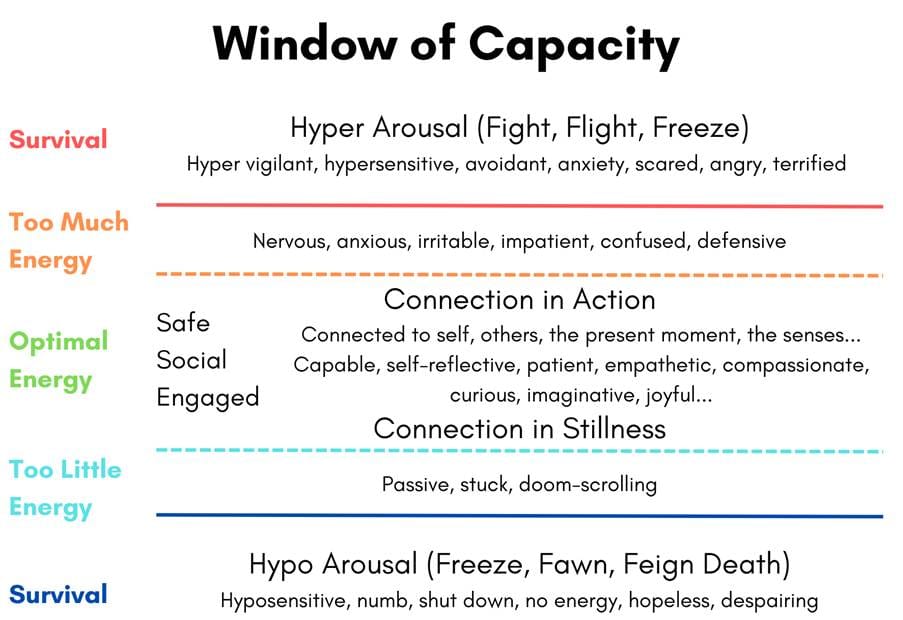
Last week we mapped the nervous system and looked at how this shows up in a scene. This week, we're going to extend that by looking at our window of capacity and also make it personal, helping you map what happens in your nervous system in your scene.
Nervous System Play
We do this by purposefully creating fear, or other usually unwanted emotions, in the boundaried regulation of a negotiated scene. The key to this is that we (almost always) don't want to fully go into either the Sympathetic Nervous System or Dorsal Vagal. We don't want to have a complete fear response; we just want to play with that response. We want to stay in the hybrid states, picking and choosing the elements we want to experience.
Here, you can see the three states on a continuum from immobilised at the bottom to mobilised at the top. In the middle is our Window of Capacity.
You may have heard this called the window of tolerance, but I prefer the name window of capacity because it refers to our capacity for things ****** of ability to tolerate things. The capacity we are talking about here is the capacity for connection (to self, the present, others); the capacity to be playful or joyful; the capacity to get stuff done.
Now, what happens when someone whose nervous system is regulated becomes dysregulated? First, they have an attachment cry — they shout for help, look for someone. If this does not work and their nervous system is not reassured, then they go into survival mode: the sympathetic nervous system. They cycle through flight, fight, freeze (and fawn), trying to survive the situation. And if these don't work, they crash down into dorsal vagal — they need to reserve energy, so in dorsal vagal they feign death and freeze.
You may notice there are two freeze states; one in sympathetic and one in dorsal vagal. When we freeze in a state of fear and activation, the muscles are tense, heart-rate is high, and the body is ready to run or fight. Meanwhile, in dorsal vagal, the muscles are limp, heart-rate is slow and we feel despondent. Both are survival responses which may look similar from the outside but are very different to the person experiencing them.
How does this relate to kink?
In a scene, we aim to embody many of the elements of regulation, but often also some of the elements of dysregulation. We switch between being connected in action (play, energy, fun) and being connected in stillness (intimacy, gentleness, caresses).
An attuned top, dealing out the fear and pain, helps the bottom regulate when it risks coming too much — these are where they drop back into their window of capacity. But this attuned top also knows their sub wants to push themselves; wants to feel real fear today. So they push their sub's nervous system up into survival — just a pinch; just a morsel of that fear.
How does this relate to kink?
And when this dance of regulation and dysregulation reaches its fever pitch; when the bottom has switched between the regulation of trust and the fear of pain for long enough, their nervous system taps out and they drop down into dorsal vagal, and subspace. From here, the scene is drawn to a close and the aftercare takes over. An intimate connection in stillness that is essential to bring both partner's nervous systems back to a place of regulation.
But why?
It's invigorating, energising; playing like this. It's fun, and it reminds you that you're alive. The cocktail of hormones (adrenaline, dopamine, oxytocin) that the nervous system uses to regulate can feel intoxicating. For some neurodivergent individuals, nervous system play is an extreme form of stimming. Many people who practice kink have experienced trauma, and nervous system play can be a way to reframe that fear response in a way that feels safe. While kink is not therapy, it can be reparative when done consciously.
There are many other reasons, but no matter what the reason is, it's essential that elements of a regulated nervous system are present in the scene. Without regulating your nervous system, you risk having a real fear response and becoming triggered.
In kink, we are not trying to dysregulate ourselves. We are playing at the edges of our capacity, while staying connected.
Mapping Your Nervous System in a Scene
Step 1: My Nervous System. Describe the three main states and what they look like for you. What does Ventral Vagal look like for you (calm, confident, playful)? How does it feel (relaxed heart rate, regular breaths, open chest)? What does Sympathetic look like (scared, stressed, overwhelmed)? How does it feel (increased heart-rate, shorter breaths, tension)? What does Dorsal Vagal look like (numb, heavy, disconnected)? How does it feel (slow heart rate, shallow breathing, collapse)?
Step 2: My Wants and Needs. Identify the parts from each state that you like or need during a scene. For example: I like to feel confident. I need to feel connected. I like to feel scared but to get there I need to feel safe. You can also identify the parts you dislike or are boundaries or hard limits: I never want to feel terror. Disconnection from my partner(s) is triggering.
All of this is something we build on over time: when a scene goes well, or when it goes wrong, we can approach it with curiosity and use that to add to this list. Your nervous system is not an obstacle to your kink. It's the ******
Disclaimer: This space centres consent, autonomy, harm reduction, and nervous system awareness. I am not a doctor and this is not medical advice.
本文要点
- Nervous System Play
- How does this relate to kink?
- Mapping Your Nervous System in a Scene